- TFS Podcast
- Support This Site

Valuable answers for valid questions about world religions, cults, worldviews and the Christian church
This site contains over 130 pages of free content in articles, videos and audio – it might be faster to use our search function to find what you are looking for
“What is a Christian?” is the key question that this page will answer. Christianity isn’t a given denomination nor is it a collection of denominations. All of the denominations, listed on our denominations page and chart, emerged from a root form of Christianity whereby they held to the essentials of the Christian faith. The earliest Christian church was established by the Lord Jesus Christ through His 12 Apostles and the Apostle Paul’s missionary journeys. Select the blue arrows at the right of the following box for a quick overview of Christianity and its history.
From the writings of the Apostles, to the times of the various councils to this very day, there is an unbroken line of correct doctrine that can be demonstrated by the preserved writings of that day. Often times when cultists try to answer the question What is a Christian? They will claim that “precious truths” were removed the Bible and from Christianity by “wicked priests” or something along those lines.
However, when pressed to show any sort of evidence of a broken line of teaching or an exact (or approximate!) time period when the “wicked priests” carried out such a removal of these bizarre new beliefs, the Christian is met with deafening silence. There isn’t an answer from the cults because the historical and archaeological record supports the orthodox Christian belief that what was taught 2000 years ago and which is still being taught today.
So with that being said, what exactly do authentic, historic, Biblically-based Christians believe that is to ask what is a Christian? For the early centuries, there was a commonly-held set of essential beliefs pertaining to the following:
Theologians would later refer to this as “Theology Proper”
Isa 44:8; Deut 6:4; 1Tim 2:5 ‘One God, One Mediator...
Theologians would later refer to as "Christology"
Salvation of mankind This occurs by way of the finished work of Jesus Christ on the cross. Theologians would later refer to this doctrine/theology as "Soteriology"
Theologians would later refer to this doctrine as Hamartiology
Jn 19:30 “It is finished” all sufficient; Eph 2:8,9
Click the blue arrow at the right of the box below to see the attributes of God according to the Biblical-historical Christian faith.
This set of beliefs were all founded upon and located in the inspired word of God – the Scriptures. They were as-yet uncodified into a standalone written “creed” or “confession” aside from Scripture but were passed down from the Apostles to the early church patriarchs either by word or by written epistle.
After a number of heresies arose, the early Christian church decided to gather together at specific councils to officially codify the already-established Christian doctrine passed on from the 12 Apostles. I’ve included a few words about the the Creeds that were assembled as a result of a couple of the major councils:
The word ‘church’ comes from ekklesia which means ‘called out ones’. The genuine scriptural Christian church is comprised of sincerely called out believers and followers of Christ Jesus who have turned from their life of sin to a life in Christ. These called out ones are collectively known as the church, the scriptural/biblical church or as the ‘invisible church.
It is called invisible because it cannot be quickly and easily identified by human means but is known by God and spiritually discerned by believers. Being a genuine “called out one” or member of the invisible church has nothing to do with denominations or schisms or creeds or councils but rather on one’s genuine conversion to Christ through repentance and faith.
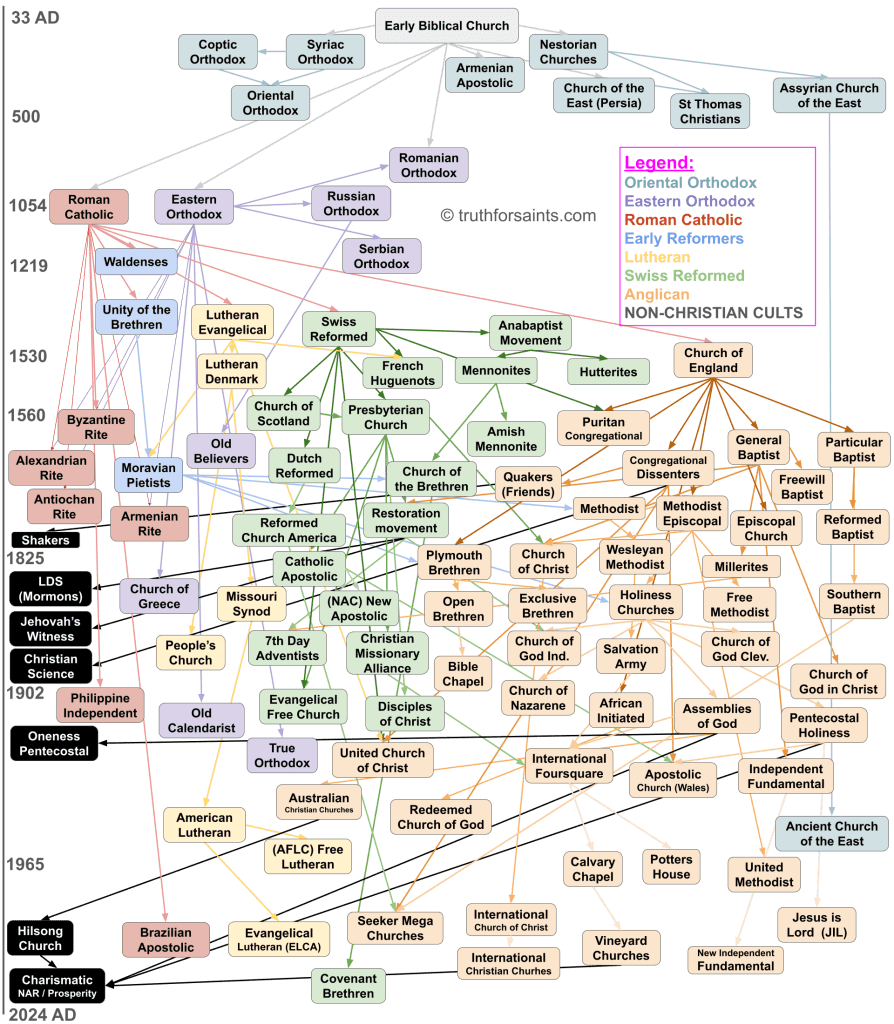
That being said, there is also a “visible” Christian church which the world looks at externally thereby defining the Christian church by what they see or record in a census of the population. This ‘visible church’ is primarily comprised of seven major families of denominations which are:
Writing started 1450 B.C. with Moses was completed 95 A.D. with the Apostle John
Jewish canon: The Law, The Prophets and the The Writings in Jerome's order:
A fulfillment of the Old Testament which was incomplete:
The attributes of God, the visual construct and ultimate authority of the believer begins to answer the question What is a Christian? But how does the Bible, which is the foundation of Christian truth compare to other religious writings like the Quran?
Are the two books the same? Is the Bible just a man-inspired man-written work like the Qu'ran? Is the Qu'ran a God-inspired God-breathed book like the Bible? Do they both say the same things? The following compare and contrast will shed some light on these questions:
The God of the Bible tells His people to differentiate Him from false gods by their inability to prophesy the future and His unique ability to prophesy the future perfectly. – Isaiah 41:22-24
No prophecies of any kind about the future are given in the Qu’ran
Monotheistic, Trinitarian, as referenced in Isa 43:10; 44:6-8; Matt. 28:19; 2 Cor 13:14
Monotheistic as referenced in Surah 5:73; 112:1-4
Denies the Trinity in Surah 5:73
Jesus is God incarnate – Colossians 2:9
Denies that Jesus is God and claims He was only a “messenger” – Surah 5:17, 75-76
Jesus was crucified on a cross – 1 Peter 2:24
Claims Jesus was not crucified at all – Surah 4:157
Jesus rose from the dead – John 2:19-20
Claims that Jesus died a normal death (after 120 years), was taken up to Allah then simply watched over his followers from heaven. Surah 3:56, 5:118
Jesus was the only Son of God – Mark 1:1
Claims Jesus was not the “Son of God” but rather a “prophet” – 9:30 – only 1 of 25 prophets listed in the Qur’an and 1 of 125,000 in the history of Islam.
Jesus said He was the Son of God – John 10:30-39, John 9:35-40, Matthew 16:13-17, Mark 14:61-64, Luke 22:70-71
Claims that Allah cannot have sons Surah 6:101
Holy Spirit, 3rd person in the Godhead. He will bear witness of Jesus – John 14:26; 15:26
Claims that the Holy Spirit is the angel Gabriel – Surah 2:97; 16:102
Salvation by grace through faith – Ephesians 2:8,9
Salvation is by sincerity and works – Surah 3:135; 7-8-9; 21:47; 49:14; 66:8-9 also by dying for the cause of Allah – Hadith, Surah 3:157
The Devil is a fallen angel – Isaiah 14:12-15; Created by Jesus – Col 1:15,16
The Devil, Satan, is not a fallen angel, but a fallen Jinn (Genie) – 2:34; 7:12; 15:27; 55:15
Man is basically evil (fallen sinner) – Romans 3:23
Man is basically good – Typical cleric teaching (contradicts a buried passage in Surah 12:53 which agrees w/ the Bible)
Disciples were followers of Christ (Christians) – Acts 11:26
Disciples declare themselves Muslims – Surah 5:111
Worship on Sabbath – Exodus 20; Then later on Sunday – Rom 14:5-6; Acts 20:7; 1 Cor. 16:1-2
Worship on Friday – Surah 62:9
Miracles, numerous are recorded
No Miracles recorded, except the claim the Qur’an is a miracle (c.f. Mormons and the Book of Mormon)
Written by 40+ authors over 1500 years – reads as one book
Written by 1 man over 23 years with multiple revisions following his death (c.f. Joseph Smith and the Book of Mormon)
To fully answer the question What is a Christian? We must address the Christian view of the afterlife. Christianity began with a Scriptural understanding of the afterlife: Mankind is fallen, sinful and at enmity with God. Therefore, when a person dies they are eternally separated from God who is the source of any and all things “good and enjoyable”.
However, if that person during their lifetime, puts their faith in Jesus as the Son of God and Savior of their sins, they do not go into separation from God (Hell) but rather, when they die they are instantly present with the Lord in a perfected state of joy, peace and gladness (Heaven).
Jesus said, "He who hears My word and believes in Him who sent Me, HAS eternal life and shall not come into judgement but has passed from death (separation) to life (heaven)."
- John 5:24 Tweet
Unfortunately, with the rise of Roman Catholicism during the low middle ages, this Biblical Gospel was exchanged for a false gospel whereby the Roman Catholic church began to preach that salvation is possible only by faith plus a requisite amount of works.
The Roman Catholic Church also introduced a new concept called “purgatory” whereby you go into a “mini Hell” to burn off those sins that you committed after being baptized at birth. Conveniently, this tradition of purgatory could be lessened by none other than the Pope himself if you were generous enough to give money into the Catholic collection bucket. This process was known as the “selling of indulgences”.
During this time, the Roman Catholic Church began to drastically move away from the sufficiency of Scripture and instead began to teach that Church tradition and the word of the Pope were equal to or greater than the Word of God in authority.
This view is still held by Roman Catholics today nearly a thousand years later. It is for this reason that Bible-believing and Bible-teaching Christians correctly consider the Roman Catholic Church to be an apostate faith due to their horrific departure from Scripture in light of manmade tradition.
This aberration would begin to crumble as Peter Waldo of the Waldensians, John Wycliffe and the Lollards, John Hus of the Unity of the Brethren and Martin Luther would begin to tirelessly call for a return to the Scriptures and would decry the abhorrent “traditions” which had replaced it and the Gospel.
Holding to the inerrancy of the scriptures, Luther challenged the erroneous Roman Catholic salvific view of ‘faith + works’ and challenged the Roman Catholic dependence on “Church tradition”. He cited multiple scripture references to that communicate that the ‘just shall live by faith’ and not “faith plus works”.

The Biblical Gospel proclaims that God saw this rebellious condition of mankind, His creation, and saw that the only remedy for this condition was an eternal payment of death (separation from the God of life) which satisfied His just, righteous and holy nature.
His love for His creation was so great, that he sent His Eternal Son to pay this eternal payment of death. Thereafter, all who would consciously put their faith in Him (Jesus) and his eternal death payment on the cross as payment for their own sins, would receive life everlasting, heaven after death and permanent relationship as sons and daughters to the Father here on earth.
Luther asserted that no fair amount of works could ‘earn’ favor with God Almighty and therefore, according to the Bible, one is saved by grace alone through faith alone (Ephesians 2:8,9). This Biblical view of the Gospel which is ultimately a view of the afterlife, involves a conscious recognition of equality with all human beings: if one is imperfect and in need of perfection to spend eternity with God, then ALL are imperfect and in need of perfection to spend eternity with God.
One is not better than another and therefore, of no need for a Savior. This view refers to sin by its original definition of ‘missing the mark’ and believes that all men have areas of ‘missing the mark’ in things they have done and have failed to do. These areas are referred to by the bible as ‘rebellion’ and as such, will have no place with a perfectly good and loving God. Not now, and especially not in eternity.

What is a Christian? Those that recognize that they have sinned against the One true eternal God and cry out to Jesus for mercy and forgiveness, putting their faith in Him alone to receive a new life now and an afterlife of heaven after they die. This view holds that those that refuse this costly gift that God gave, will simply continue in the condition of rebellion that all men exist in outside of Jesus’ payment on the cross.
If the refuser remains in this state of rebellious refusal at the point of their death, then that person is simply granted their lifelong desire for eternity: separation from a God that gave Himself for their sins (Hell=separation from all this good). This will be an horrific shock for many when all of the good things they received from God in their mortal life completely disappear with God from their eternity.
All three views are the imaginations of men and have no validity in Scripture.
If I am a Bible-believing Christian, I would have begun by recognising that I am no different from everyone else in the world in that I ‘miss the mark'(sin) in many ways and this sin is against an eternal God and carries an eternal penalty/wage.
“For the wrath of God is revealed from heaven against all ungodliness and unrighteousness of men, who suppress the truth in unrighteousness, because what may be known of God is manifest in them, for God has shown it to them.” – Romans 1:18-19
All that the Father gives Me will come to Me, and the one who comes to Me I will by no means cast out. – John 6:37
But as many as received Him, to them He gave the right to become children of God, to those who believe in His name: who were born, not of blood, nor of the will of the flesh, nor of the will of man, but of God. – John 1:12
“For therein is the righteousness of God revealed from faith to faith: as it is written, The just shall live by faith.” – Romans 1:17
“But that no man is justified by the law in the sight of God, it is evident: for, The just shall live by faith.” – Galatians 3:11
“Now the just shall live by faith: but if any man draw back, My soul shall have no pleasure in him.” – Hebrews 10:38
No one receives eternal life and eternal presence with God (from Whom all good things come – James 1:17), by belonging to the right church, denomination, world religion, or by having a particular world view. Rather only those who trust in the Lord Jesus (preached by the Apostles in the Bible) for their own sin.
We will not trust in a Savior for sins that we either don’t believe we have or that we think aren’t deserving of hell. But the Bible says that ALL have sin and the wages of that sin is eternal separation from God (death). The good news is that the Bible says that you can know that YOU have eternal life. Click the button below to see if you are genuinely saved from your sins according to the Bible: